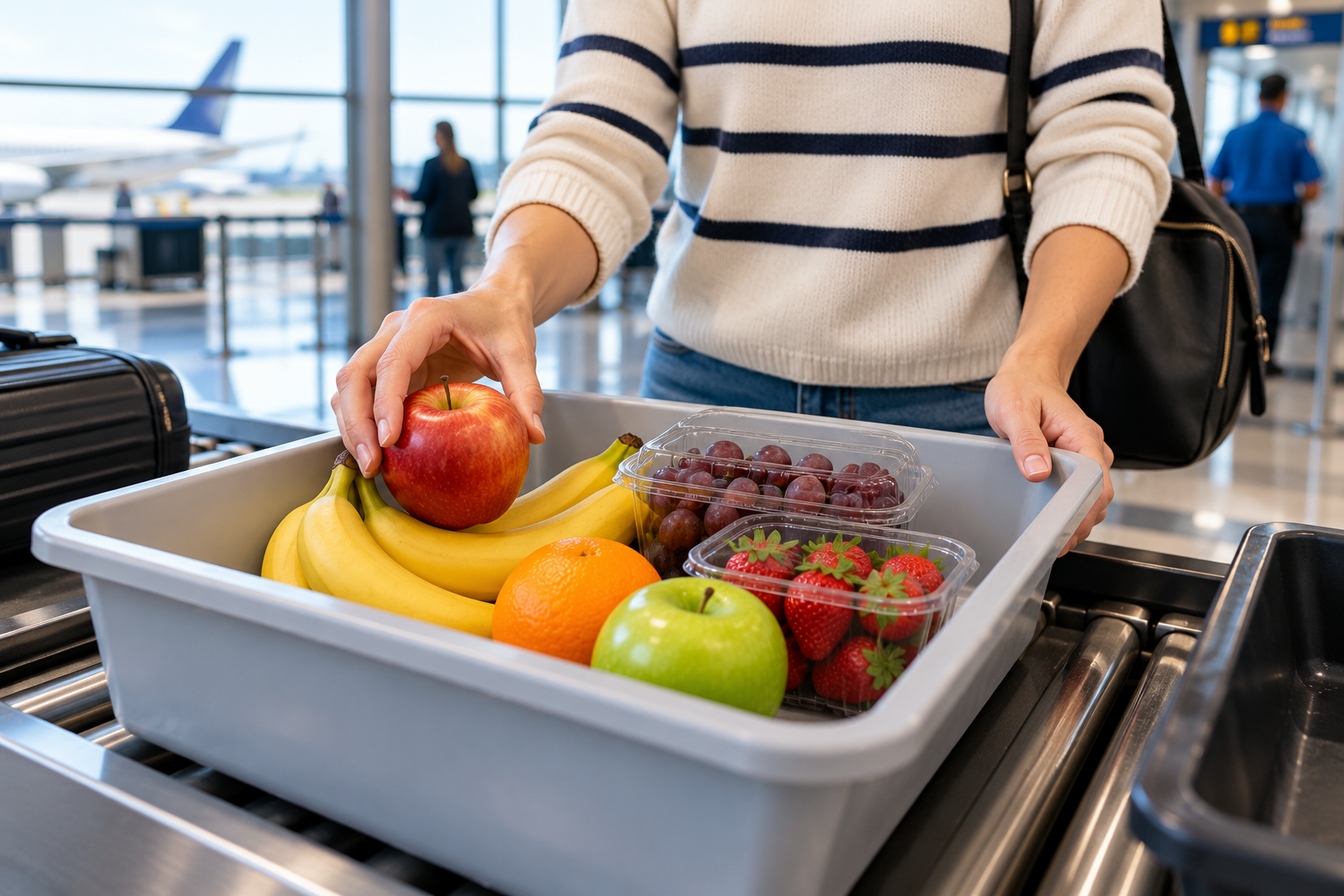
Yes. On ordinary flights within the continental United States, you can usually bring fresh solid fruit through TSA in either your carry-on or checked baggage. Apples, bananas, grapes, oranges, berries and similar fruits are generally allowed.
The important exception is agricultural regulation. TSA rules determine whether food can pass through airport security; customs and agriculture rules determine whether fresh produce can legally enter your destination. That distinction matters for international travel and for trips involving Hawaii, Puerto Rico or the U.S. Virgin Islands.
Can You Bring Fruit on a Plane?
For ordinary continental U.S. travel, TSA permits fresh fruits and vegetables in both carry-on and checked bags.
That includes common whole fruits such as:
- apples;
- bananas;
- grapes;
- oranges;
- lemons;
- strawberries;
- blueberries;
- cherries;
- peaches;
- mangoes.
Fresh vegetables follow the same general TSA rule.
The TSA rule applies to security screening. It does not override agricultural restrictions that may apply at the destination.
Which Fruits Can You Bring Through TSA?
| Fruit | Through TSA on an ordinary continental U.S. flight? |
|---|---|
| Apple | Yes |
| Banana | Yes |
| Grapes | Yes |
| Orange | Yes |
| Lemon | Yes |
| Strawberries | Yes |
| Blueberries | Yes |
| Cherries | Yes |
| Peaches | Yes |
| Mango | Yes |
| Cut fruit | Usually yes if it remains solid food |
| Vegetables | Yes |
This table refers specifically to TSA screening on ordinary travel within the continental United States. It does not mean each fruit is automatically legal to carry across an international border or agricultural checkpoint.
Can You Bring Fruit Through TSA?
Yes. Fresh fruit is generally considered solid food and may normally go through TSA security.
Solid foods can usually be packed in:
- a carry-on;
- a personal item;
- checked baggage.
A TSA officer may still request additional screening. Food can sometimes make the X-ray image harder to interpret, so you may be asked to remove food from your carry-on during screening.
TSA also retains final authority at the checkpoint if an item raises a security concern.
Can You Bring an Apple, Banana, Grapes or Oranges Through TSA?
You do not need a separate TSA rule for every individual fruit. They fall under the broader fresh-fruit and solid-food rules.
Apples
Yes. A whole apple is normally permitted through TSA on a continental domestic trip.
Bananas
Yes. Bananas are normally fine through airport security.
Grapes
Yes. Grapes can go through TSA. A container or resealable bag can help prevent them from getting crushed in your luggage.
Oranges and Lemons
Yes under ordinary TSA security rules.
Strawberries, Blueberries and Cherries
These are also permitted as fresh solid fruit.
Mangoes and Peaches
TSA generally allows them as well. Agricultural restrictions at the destination are a separate issue.
Can You Bring Fruit in Your Carry-On?
Yes.
Whole fresh fruit can normally be placed directly in your carry-on or personal item. It is practical to use a container or resealable bag, particularly for soft fruit and berries.
If you plan to cut the fruit during the trip, remember that ordinary knives are not permitted in carry-on baggage. Pack any prohibited sharp item appropriately in checked baggage instead.
Can You Bring Fruit in Checked Baggage?
Yes under TSA rules.
Putting an apple, orange or other fresh fruit into checked baggage is normally acceptable for ordinary travel within the continental United States.
However, checked baggage does not provide a way around customs or agricultural restrictions.
If a country, state or territory restricts a particular fresh fruit, putting it in your suitcase rather than your carry-on does not change the rule. Checked luggage can also be subject to agricultural inspection.
Can You Bring Cut Fruit on a Plane?
Usually, yes on a domestic U.S. flight if the fruit remains solid.
Examples include:
- apple slices;
- orange segments;
- melon pieces;
- berries;
- sliced peaches.
The situation changes when the container includes a substantial amount of liquid, syrup, juice or a gel-like mixture.
TSA’s carry-on liquid rules generally limit liquids and gels to containers of 3.4 ounces or 100 milliliters unless an exception applies.
So a container of dry apple slices is treated differently from a large container filled with fruit and juice.
For international agricultural rules, cutting the fruit does not necessarily help. When entering the United States, USDA states that almost all fresh fruits and vegetables are prohibited whether they are whole or cut.
Can You Bring Fruit on a Domestic Flight?
For a typical flight entirely within the continental United States, yes.
Fresh fruits and vegetables can generally travel in both carry-on and checked baggage.
The wording “domestic flight,” however, can be misleading because agricultural restrictions apply to certain movements involving:
- Hawaii;
- Puerto Rico;
- the U.S. Virgin Islands.
So it is safer to think in terms of ordinary continental U.S. travel rather than assuming that every domestic route follows identical produce rules.
Special Rules for Hawaii, Puerto Rico and the U.S. Virgin Islands
Agricultural controls are particularly important on these routes because fresh produce can carry insects, plant diseases and other agricultural pests.
Hawaii to the U.S. Mainland
USDA APHIS restricts many agricultural items moving from Hawaii to the continental United States.
Most fresh fruits and vegetables cannot simply be packed and taken to the mainland. Travelers must present agricultural items for USDA inspection before departure.
There are exceptions. For example, fresh pineapple is among the products that may be allowed after inspection, and some treated fruits can travel if they meet USDA requirements.
USDA APHIS — Traveling From Hawaii
Puerto Rico and the U.S. Virgin Islands to the Mainland
Agricultural inspection also applies to travel from Puerto Rico and the U.S. Virgin Islands to the mainland.
Fresh fruits and vegetables are heavily regulated. Some specific products are permitted after inspection, while others are prohibited.
Do not assume that a fruit is unrestricted simply because the trip does not cross an international border.
Traveling to Hawaii
Travelers arriving in Hawaii must declare agricultural items, including fruits, vegetables and other plant material, and present them for inspection when required.
Some produce is permitted after inspection, while certain plant products are restricted or require special treatment or documentation.
The central rule is simple:
TSA clearance is not the same as agricultural clearance.
Can You Bring Fruit on an International Flight?
Possibly — but two completely different sets of rules are involved.
Getting the Fruit Through U.S. Security
If fresh fruit is solid food, TSA will generally allow it through the security checkpoint.
Taking the Fruit Into Another Country
The destination country’s customs and agriculture authority decides whether the fruit can actually enter.
A country may:
- allow it;
- require declaration;
- require inspection;
- restrict particular fruits;
- prohibit fresh produce altogether.
So an apple can be perfectly acceptable at a TSA checkpoint in the United States and still be illegal to carry through customs when you land.
Before an international trip, check the official agricultural or customs rules of the destination country.
Can You Bring Fruit Into the United States From Another Country?
The rules are much stricter.
USDA APHIS states that almost all fresh fruits and vegetables, whether whole or cut, are prohibited from entering the United States from foreign countries because they can carry pests and diseases.
That can include fruit:
- purchased at your destination;
- taken from a hotel;
- bought in an airport;
- given to you during a flight or cruise.
There are exceptions depending on the product, country of origin, treatment and required documentation, so the rule is not literally “no fruit can ever enter.”
But for an ordinary traveler, the safest assumption is that fresh fruit may not be admitted unless official rules specifically confirm that it is allowed.
USDA APHIS — International Traveler: Fruits and Vegetables
Do You Have to Declare Fruit at Customs?
When entering the United States from another country, agricultural products must be declared.
That includes fresh:
- fruit;
- vegetables;
- plant products;
- other regulated agricultural items.
Do not decide for yourself that an item is safe enough to skip declaration.
Declare it and let the agricultural inspector determine whether it can enter.
USDA also recommends keeping original packaging, receipts or country-of-origin information when relevant. Properly declaring an item is important even if an inspector ultimately decides that it cannot enter the country.
Can You Bring Vegetables on a Plane?
Yes under the same general TSA framework used for fresh fruit.
For an ordinary continental U.S. flight:
- carry-on: generally yes;
- checked baggage: generally yes.
International and agricultural restrictions remain separate. Fresh vegetables entering the United States from abroad are subject to the same strict USDA controls as fresh fruit.
Quick Rule Table
| Situation | Fresh fruit allowed? |
|---|---|
| Through TSA on continental U.S. flight | Usually yes |
| Carry-on on continental U.S. flight | Yes |
| Checked baggage on continental U.S. flight | Yes |
| Apple / banana / grapes through TSA | Yes |
| Cut fruit through TSA | Usually yes if solid |
| Fruit packed in significant liquid or syrup | TSA liquid rules may apply |
| Hawaii → U.S. mainland | Many fruits restricted; inspection required |
| Puerto Rico / USVI → U.S. mainland | Agricultural restrictions and inspection apply |
| U.S. mainland → Hawaii | Declare agricultural items; restrictions may apply |
| International flight leaving U.S. | TSA may allow it; destination rules control import |
| Entering U.S. from another country | Almost all fresh fruit prohibited; declaration required |
For a normal flight within the continental United States, taking an apple, banana, grapes or most other fresh fruit through TSA is generally straightforward. The bigger issue is where the flight is going: agricultural restrictions can apply to Hawaii and U.S. territories, while international customs rules may prohibit fresh produce entirely. On international trips, check the destination’s agricultural rules rather than assuming TSA approval means the fruit can enter the country.